

I have worked in these markets for more than fifteen years. By the time I started, trading had already moved onto the screen. I worked at Sharekhan, spent years around investment and wealth management, handled corporate portfolios and interacted closely with family offices.
Today, as the founder of Hedged.in, I still find myself having versions of conversations I first had well over a decade ago.
The circumstances keep changing, but the question does not.
I first heard it as a young trader in the years after the 2008 crash. I heard it again in 2013, and in 2018. I heard it when COVID shut the world down in 2020. I hear it whenever oil jumps, geopolitics deteriorates, or markets enter another uncomfortable period.
“Rahul, when will the market go up?”
People often assume that all these years in markets should have made me better at answering that question. In reality, they have made me much less interested in answering it.
Because I eventually noticed something more useful.
Nobody asks me this question when their portfolio is doing well. The question appears only when something has already started hurting. That is why I no longer hear it merely as a request for a market forecast. More often, I hear another question hiding underneath it: how long am I going to have to feel like I made the wrong decision?
That is where market psychology becomes far more interesting than market prediction.
The number you are really watching
Ask an investor what they mean when they say they want a stock to “recover,” and you will often discover that they are not talking about the business, the index or even valuation.
They mean their purchase price.
Suppose someone buys a stock at ₹1,000 and it falls to ₹760. From that point onward, ₹1,000 acquires an importance completely disproportionate to its financial meaning. Every rise toward it feels like progress. Every fall away from it feels like another setback. Yet nothing particularly important happens to the company when the share price crosses ₹1,000.
The number matters because you were there. It is the price at which you committed money and, perhaps without realising it, also committed your judgement. You did not merely buy a stock. You made a decision about what you believed that stock was worth.
That is why losses become personal so quickly.
An investor tells himself he wants his capital back, but often what he really wants is his judgement back. He wants the screen to confirm that he was not foolish, premature or wrong. Getting back to the purchase price becomes a form of emotional acquittal.
I have watched this happen with sophisticated investors as well as beginners. Intelligence does not remove it, because the instinct is not intellectual. The market, of course, has no relationship with that number. It does not know where you bought. It has made no promise to return there.
Your purchase price is one of the most important numbers in your head and one of the least
important numbers to everybody else participating in the market. Once you understand that, you begin to see why “When will the market go up?” can become such an exhausting question. The investor is not merely waiting for prices to rise. He is waiting for the market to validate him.
The hidden cost of a bear market is time
Investors usually describe a difficult market in percentages. The index fell 12%. The portfolio corrected 18%. A particular stock is down 30%.After years of watching people live through these periods, I think percentages explain only part of the experience.
There is another variable: time spent underwater.
A sharp fall is frightening, but prolonged uncertainty can be psychologically worse. The first month produces fear. The third month produces doubt. After enough time, investors begin rewriting the story they originally told themselves.
Part of this is simply how we are built.
Kahneman and Tversky demonstrated that a loss is felt roughly twice as intensely as an equivalent gain, which is why a portfolio down 18% does not sit on the mind the way an 18% gain once lifted it. It presses down harder, and it keeps pressing for as long as the position stays red.
A company they once considered exceptional now looks questionable. A sensible asset allocation begins to look naïve. The same investor who was delighted to buy at a higher
valuation starts wondering whether buying at all was a mistake. The information may not have changed enough to justify this transformation.
Time did it.
That is why I think markets are measured in percentages, but investors often
experience them in mornings. You wake up and check the portfolio. You check the news. Someone sends a gloomy article in a WhatsApp group. A television expert predicts another correction. By lunchtime, perhaps nothing material has happened to the businesses you own, yet psychologically you have lived through another full day of uncertainty. Do that for three months and the problem is no longer merely a falling market.
The investor becomes tired of not knowing.
This distinction matters because many poor investment decisions are not made at the
point of maximum financial loss. They are made at the point of maximum psychological
fatigue.
The person finally says, “I cannot take this anymore.” That sentence is worth paying attention to. It rarely means the investment thesis has changed. It often means the experience has become unbearable.
The question changes when the capital changes
One of the more interesting things I learned while working around family offices was that larger and more sophisticated pools of capital often approached difficult markets differently.This is not because wealthy investors are somehow immune to fear.
They are not.
But the better ones ask a different first question. A retail investor will often begin with: when will this recover? A family office is much more likely to begin with: what has changed? Those questions sound similar. Psychologically, they are worlds apart.
“When will it recover?” places the investor’s attention on price and time, two things
over which he has almost no control. “What has changed?” forces attention back onto
evidence.
Have earnings deteriorated? Has leverage become dangerous? Has the competitive
position weakened? Has management changed its behaviour? Has valuation improved
enough to alter the risk-reward equation? Or has the price simply fallen because
liquidity and sentiment have changed?
That is a much more demanding way of thinking, but it also removes some of the
emotional urgency.
Over the years, this has become one of the clearest differences I notice between
investors who survive difficult periods well and those who constantly need someone to
tell them what comes next.
The better investor is not necessarily better at prediction. He is better at diagnosis.
And that difference becomes extremely valuable when everybody else is desperate for
a forecast.
Why the beginning of a recovery feels so unconvincing
There is another reason the question “When will the market go up?” is almost
impossible to answer satisfactorily.
When markets finally begin recovering, they rarely feel recovered. Investors imagine the turn as a moment when uncertainty disappears and confidence returns. In practice, the sequence is usually messier. Prices begin responding while the news still looks uncomfortable.
The first rally is dismissed as temporary.
The second is called a dead-cat bounce. Every good day is treated with suspicion, because investors have been trained by the previous months to expect disappointment. This creates something I have come to think of as recovery blindness.
After staring at danger for long enough, the mind becomes better at recognising reasons for another fall than evidence of improvement. That is not stupidity. It is adaptation.The problem is that the adaptation that protected you during the decline can become the very thing that prevents you from participating in the recovery.
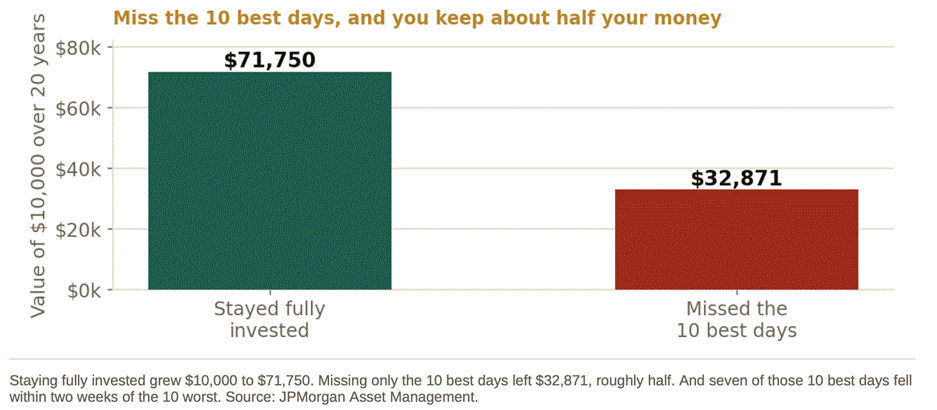
The numbers are unforgiving on this point. Over the past twenty years, seven of the market’s ten best days arrived within two weeks of its ten worst. An investor who stepped aside and missed only those ten best days would have ended with roughly half the wealth of one who simply stayed invested. The best days do not wait for the fear to clear. They tend to happen inside it, on mornings that feel no different from all the others.
The best days hide inside the worst weeks
The value of $10,000 left in the market over 20 years.
Investors say they are waiting for clarity. What they often mean is that they are waiting to feel comfortable. But markets do not normally deliver comfort before opportunity. If they did,
opportunity would be priced very differently.
There is a stranger pattern beneath all of this. Markets often turn not when the fear is loudest, but when it finally goes quiet. As long as the question is still being asked everywhere, when will it go up, there is hope left in the market, and hope means there are still tired holders waiting for a rally so they can sell into it. The turn tends to arrive closer to surrender, when people stop waiting and stop asking altogether.
John Templeton put it in a line that has aged well: the time of maximum pessimism is the
best time to buy. Maximum pessimism seldom sounds like panic. More often, it sounds
like silence.
This is why the early part of a recovery almost always looks undeserving of trust. Confidence arrives later, after enough evidence accumulates and enough prices have already moved.By then, the investor who wanted certainty finally receives it. He simply receives it at a higher price.
After all these years, I listen differently
I no longer dismiss someone when they ask me when the market will go up. It is a perfectly human question.
But I listen differently now. I want to know what has made them ask it. Is the business deteriorating, or is the portfolio merely red? Has their financial situation changed, or have they simply spent too many weeks watching prices? Are they questioning the investment, or are they questioning themselves?
Those distinctions matter far more than another target for the Nifty.
Markets have transformed dramatically since I began working in them. Information moves faster. Trading is cheaper. Products are more sophisticated. Investors have access to tools that would have been unimaginable when I started. Human behaviour has not upgraded at the same speed. We still anchor to prices. We still mistake discomfort for danger. We still look for
somebody to remove uncertainty. We still become confident after prices rise and frightened after they fall.
And whenever a difficult market lasts long enough, the same question eventually returns. “When will the market go up?”
After all these years, my answer is less satisfying than a date or a target, but probably more useful. The market may begin recovering long before you feel that it has. Which is why the harder skill in investing has never been predicting the day the market turns.