

Retail investors are now being invited into the pre-IPO and private-deal world the wealthy have always owned. Here is the machine underneath the returns, and why the invitation alone is not enough.
A friend recently asked me a question I am hearing more and more: “How do these family offices and big investors make so much money? I want to invest the same way.” It is a fair question, and a natural one. When you watch the wealthy quietly get rich from pre-IPO deals, startups and private funds that never appear on your trading app, it is hard not to want in. But there is a problem hiding inside that question. You are seeing the green part, the returns, the exits, the success stories. You are not seeing the machine that produced them. And lately that machine is being sold to you in a cheaper package, which makes understanding it more urgent than ever.
First, understand that this is a real and fast-growing world. India’s family offices, the private investment teams of the very rich, have grown from just 45 in 2018 to about 300 in 2024, and could cross 1,000 by 2030. They already manage more than $30 billion, on the way to $45 billion. India now ranks third in the world for the number of venture-capital deals its family offices do, behind only the US and UK. Above them sit 85,698 dollar-millionaires. This is not a niche. It is a professional industry, and it plays a completely different game from the one on your phone.
A whole professional industry, not a lucky few
Number of family offices in India.
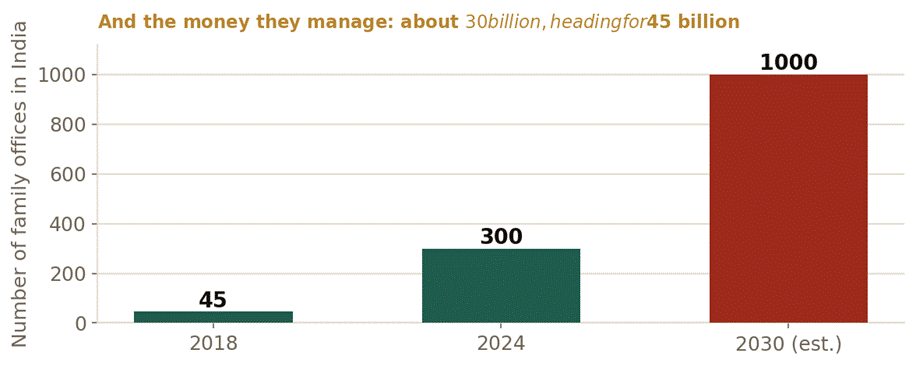
From 45 in 2018 to about 300 in 2024, managing $30B+ and on track for 1,000 by 2030; India is now 3rd globally on family-office VC deal volume. Sources: PwC; Sundaram Alternates; Knight Frank.
You see the returns. You do not see the machine.
When a family office makes 20 times its money on a startup, you hear about the 20 times. You do not hear about the 5 other startups in the same portfolio that quietly went to zero. That is the first thing hidden from view: the wealthy do not make one brilliant bet. They make 40, expecting most to disappoint and a few to pay for everything. A single pre-IPO punt with your savings is not a strategy. It is one line from a strategy you cannot afford to run.
The second hidden layer is the team. A family office is not a rich person with a trading app. It is a small company, with fund managers, analysts, lawyers and tax advisors whose full-time job is to read the fine print, check the founder’s claims, and negotiate the terms before a single rupee moves. When you buy an unlisted share off an app, you are doing none of that. You are trusting a price someone else set, on the information someone else chose to show you.
The third layer is time. The rich can lock money away for 10 years without flinching, because it is a small slice of a much larger pool. That is how they sat on unlisted shares of the National Stock Exchange for a decade, waiting for an IPO that kept slipping, first promised around 2016 and only filed in June 2026. If your money has to come back in 2 years for a home or a wedding, an investment you cannot exit is not an opportunity. It is a cage.
The fourth layer is access itself. When a genuinely good private deal appears, the best rounds go to the biggest, most connected investors first. By the time it reaches an ordinary buyer through an app or a distributor, the price has usually been marked up and the easy money already taken. Often you are not being offered the same deal the family office got. You are being offered its leftovers, at a higher price.
The same deal, two very different players.
Why ‘investing like a family office’ is harder than it looks.
| A family office brings | You bring | |
| Access | First pick of the best rounds | The leftover shares, at a marked-up price |
| A team | Managers, analysts, lawyers, tax advisors | A WhatsApp forward and a rumour |
| Number of bets | Spread across 20–50 private positions | Often one, sometimes all the savings |
| Staying power | Can lock money away for 10+ years | May need that money next year |
| What one zero costs | A dent they barely feel | A hole that takes years to recover |
The wealthy do not just buy different deals. They bring a whole machine to them. Copying only the visible step is the mistake.
The green part is real. So is the graveyard.
None of this means private markets are a trick. The gains are real.
In 2010, Info Edge put about Rs.86 crore into a small startup called Zomato; that stake is worth close to Rs.32,000 crore today. When Walmart bought Flipkart for $16 billion in 2018, early backers such as Accel made 25 to 30 times their money. But look closely at who those winners were: professional investors, with teams, patience and dozens of other bets, not one person following a tip.
The very same world produced Byju’s, once worth $22 billion and now effectively zero, and years of NSE shares that simply could not be sold. The professionals survived Byju’s because it was one bet among many. A retail investor who had put a big chunk of savings into it did not.
And now the door is opening to you
This used to be a distant world. It is not any more.
In April 2025, SEBI created a new product called a Specialised Investment Fund, letting people in with Rs.10 lakh instead of the far larger sums private strategies once demanded. Apps now sell unlisted and “pre-IPO” shares, NSE among them, to ordinary investors, wrapped in the language of exclusivity and grey-market premiums. The room the wealthy have always owned is being opened to retail, one cheaper ticket at a time. That is not automatically a bad thing. But it means the invitation is now reaching millions of people who have the FOMO of a family office and none of the machine.
Why the invitation feels so hard to refuse
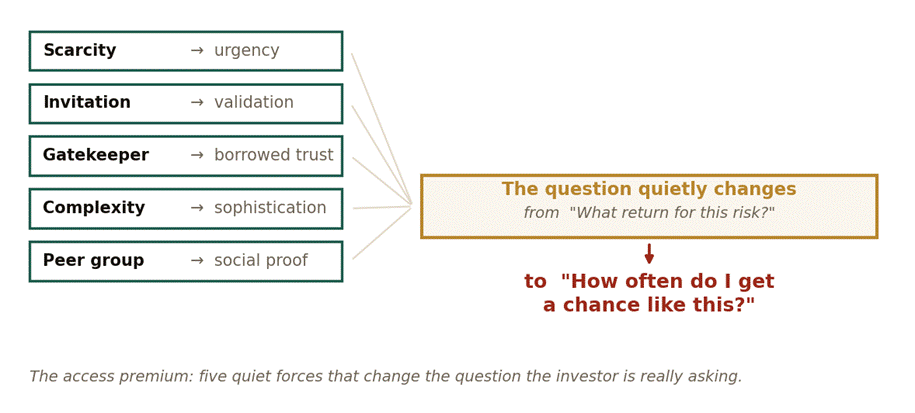
There is a reason a private deal feels special even before you have checked the numbers. A public stock looks ordinary, because anyone can buy it and its price moves every second for the world to see. A private one arrives quietly, through someone you trust, wrapped in a story and a short list of names. Scarcity makes it feel valuable. The invitation makes you feel chosen. The trusted messenger makes the homework feel already done. Slowly the question in your head changes, from “what return should this risk pay me?” to “how often do I get a chance like this?” Those are not the same question, and only the first one protects your money.
How the feeling of access changes the question
The quiet forces that make a private deal feel safer than it is.
Before you chase it, ask five simple questions
The point is not that retail investors must stay away from private markets forever. It is that you should walk in with your eyes open, not with FOMO. Before writing any cheque into a pre-IPO deal, an unlisted share or a fancy private fund, ask yourself five plain questions:
- Would I still want this if it were an ordinary listed stock anyone could buy?
- Can I check the claims myself, without relying on the person selling it to me?
- Am I fine if this money is completely locked up for five or ten years?
- If this went to zero tomorrow, would it be a dent, or a disaster for my family?
- Am I buying because the deal is good, or because being let in feels good?
The Closing
So how do family offices really make so much money? Not with one magic deal.
They win with access, a full-time team, dozens of bets, and the patience to wait ten years, all things a single retail investor almost never has. Copying only the part you can see, the pre-IPO cheque, without the machine behind it, is not investing like the rich. It is taking their risk without their safety net. For most people, the boring path, a diversified fund, held for years, quietly captures a large share of the same growth without the trap. The rich are not smarter than you. They are just better protected. Until you can build that protection, the wisest move is to admire the room from outside, and refuse to pay the price of the invitation.
#InvestorPsychology #RetailInvestors #FamilyOffices #PrivateMarkets #PreIPO #FOMO #IndianMarkets
SOURCE NOTES
1. India family offices: 45 to ~300, $30B to $45B AUM (PwC; Sundaram Alternates). https://www.business-standard.com/industry/news/family-offices-in-india-rise-from-45-to-300-in-6-yrs-handle-30-bn-in-aum-124090500628_1.html
2. India 3rd globally on family-office VC deal volume (PwC Global Family Office Deals Study 2025). https://www.pwc.in/assets/pdfs/the-evolution-of-family-offices.pdf
3. India HNWI population (Knight Frank): 85,698 HNWIs, 4th globally. https://www.ibef.org/news/india-ranks-fourth-globally-with-85-698-super-rich-behind-the-united-states-china-and-japan
4. Info Edge’s early Zomato stake: ~₹86 crore to ~₹32,000 crore. https://www.whalesbook.com/news/English/Tech/Rs-86-Cr-to-Rs-32000-Cr-Info-Edges-Zomato-Masterstroke-Unveiled/69560e3c4342f77179f4455c
5. Flipkart–Walmart $16B deal; Accel/Tiger early-investor returns. https://www.business-standard.com/companies/news/tiger-global-accel-binny-bansal-exit-flipkart-with-blockbuster-returns-123073100784_1.html
6. NSE unlisted shares, valuation and DRHP filing (June 2026). https://blog.stockedge.com/nse-ipo-details/
7. Byju’s: from $22 billion to zero (write-downs, insolvency). https://www.cnbc.com/2024/03/01/the-rise-and-fall-of-byjus-once-a-startup-darling-in-india.html
8. SEBI Specialised Investment Funds (SIF), effective 1 April 2025, ₹10 lakh minimum. https://groww.in/blog/specialised-investment-funds
9. US SEC, Investor Bulletin: Private Placements under Regulation D. https://www.sec.gov/resources-for-investors/investor-alerts-bulletins/updated-investor-bulletin-private-placements-under-regulation-d