

Research, experts, social media, and AI have made information almost unlimited. The harder investing skill may now be deciding what deserves to change your mind.
Rahul Ghose
Twenty years ago, if I wanted to understand a company, there were only some places I could go. I could read the annual report, speak to a broker, follow the financial newspapers, look at the numbers available to me, and then make a decision.
Today, a retail investor sitting at home can do much more before breakfast.
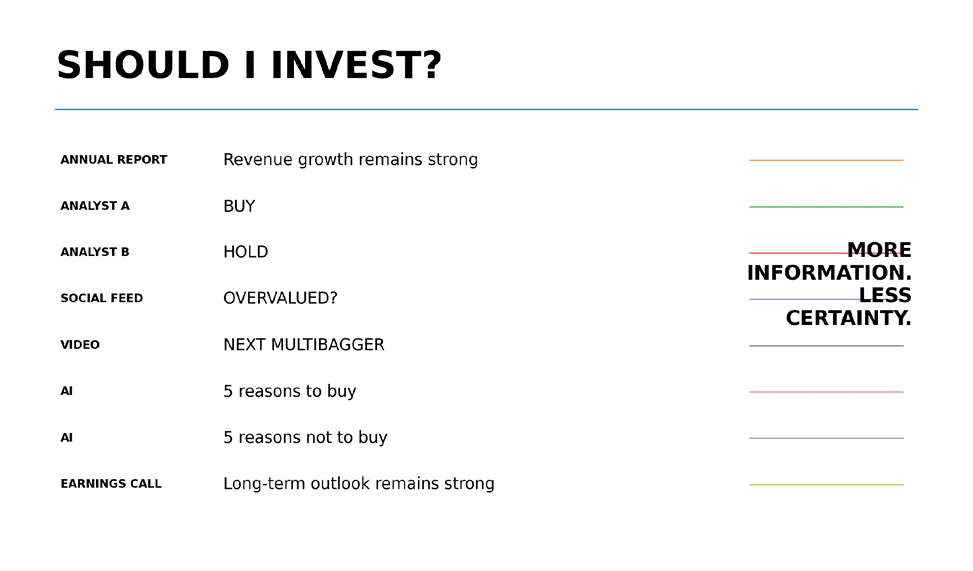
You can read the annual report and the latest earnings call transcript. You can pull up ten years of financials, compare the company with five competitors, watch analysts discuss it on YouTube, see what investors are saying on X or Reddit, and ask AI to explain the balance sheet in simple language. If you want, you can ask the same AI to give you the bull case, the bear case, and ten things you may have missed.
By every logical measure, we should be entering an age of extremely confident investors.
I am not sure that is what is happening.
Sometimes an investor begins with one question: Should I buy this company? -And two hours later has twelve questions open in twelve different tabs.
The investor knows more than when the research started. But the decision may actually feel harder.
Information used to answer questions. Now it can keep reopening them.
This is the first change I think we underestimate. There used to be a natural end to research because information itself took effort to find. Today, there is almost always another opinion available.
Suppose you like a company after reading its results. You search for the bear case. Someone points out that margins may come under pressure. You investigate that and find an analyst who thinks the concern is exaggerated. Then somebody on social media says the entire sector is expensive. You look at valuations. Now you are unsure again.
None of this information is necessarily useless. In fact, some of it may save you from making a bad decision. The problem begins when the investor no longer knows which new piece of information deserves to change the original view.
Psychology research on choice overload has found that difficult decisions, complex choices, and uncertainty about our own preferences can reduce confidence and increase regret or decision delay. Investing today has all three ingredients in abundance.
There is a point after which more research may stop reducing uncertainty and simply give uncertainty more places to hide.
“More research may stop reducing uncertainty and simply give uncertainty more places to hide.”
The strange thing is, where are we getting all this information from
SEBI’s Investor Survey 2025 gives us a useful picture of this new information environment. Among surveyed investors, 59% said they use friends, family, and colleagues as a source of information on securities-market products. Fifty-six percent use financial influencers. Thirty-four percent use online investment communities such as WhatsApp, Telegram, Reddit and Facebook groups. Market or company analysis reports were used by 25%.
The same survey found that 93% of surveyed investors considered finfluencers moderately to highly credible, while 62% said they made at least some investment decisions based on influencer recommendations.
That does not mean every influencer is wrong or every analyst report is right. It tells us something more important: the modern investor is not dealing with a shortage of voices. The investor is dealing with many voices carrying very different levels of knowledge, incentives, and evidence.
SEBI itself made a similar point in a 2026 speech on information asymmetry. Access to information is becoming easier to obtain. The harder problem is how people interpret the same facts when confirmation bias, overconfidence, optimism, and fear of missing out enter the picture.
We have spent years trying to democratise access to financial information. The next problem may be helping investors decide what deserves their attention.
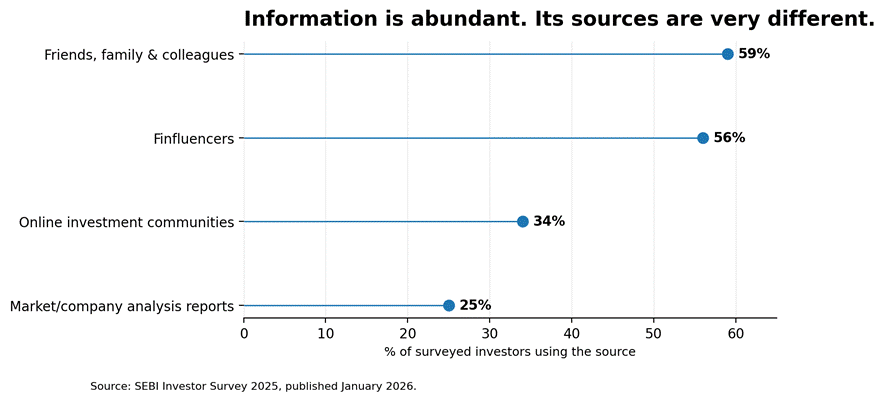
The sources themselves are part of the investing problem: they carry different incentives, evidence, and levels of expertise.
AI makes this even more interesting
I use AI, and I think it can be extremely useful for investors when used properly. A retail investor can now ask questions that once required hours of work.
Explain why this company’s margins fell. Compare its debt with three competitors. Summarise the last four earnings calls. What are the biggest risks in this business? What would have to happen for this investment thesis to fail?
That is extraordinary access.
But AI introduces a new psychological problem because it is very good at helping us build an argument.
Suppose I already like a stock. I can ask: “Give me five reasons this company could double over the next five years.” I will probably receive a neat, convincing answer.
Then I can open another prompt and ask: “Give me five reasons this stock could fall 40%.” That answer may sound equally convincing.
The investor still has to decide which facts matter more. AI can organise the evidence. It can help us find questions. It can challenge an assumption. But the responsibility for weighing those facts still sits with the investor.
This is why I don’t think AI removes uncertainty from investing. In some cases, it may show us just how many different stories can be built from the same set of facts.
We are confusing being informed with having conviction
Ask an investor why they own a particular company’s stock and listen carefully to the answer.
Sometimes you will hear ten different reasons: the sector is growing, an analyst likes it, management sounded confident, a famous investor owns it, the chart looks strong, AI says the valuation is reasonable, and somebody expects earnings to surprise.
That can sound well-researched. It can also make the investment very difficult to manage when the stock falls.
Here is a question I think investors should answer before they buy: If this stock falls 25% tomorrow, what information would make me sell it?
If you don’t know the answer before the fall, you will probably start searching for it after the fall.
That is a very different research environment. You are no longer calmly trying to understand the company. You are looking at a red number in your portfolio and trying to decide whether you made a mistake.
Now every negative article feels more important. A bearish post you might have ignored two months ago suddenly looks intelligent. An analyst downgrade feels like evidence. Someone saying “I told you so” can become surprisingly persuasive.
The information may not have changed very much. Your emotional state has changed the weight you give it.
That is why conviction cannot simply mean having consumed a lot of information. Conviction should mean understanding why you made the decision and knowing what would make you change it.
Maybe the missing investing skill is knowing when to stop researching
This is something investors in the past did not have to think about in quite the same way.
Information scarcity created its own stopping point. Eventually, you had read what was available.
There is no stopping point anymore.
There will always be another research report, another video, another podcast, another post, another expert, and now another AI prompt.
So perhaps the modern investor needs a research stopping rule.
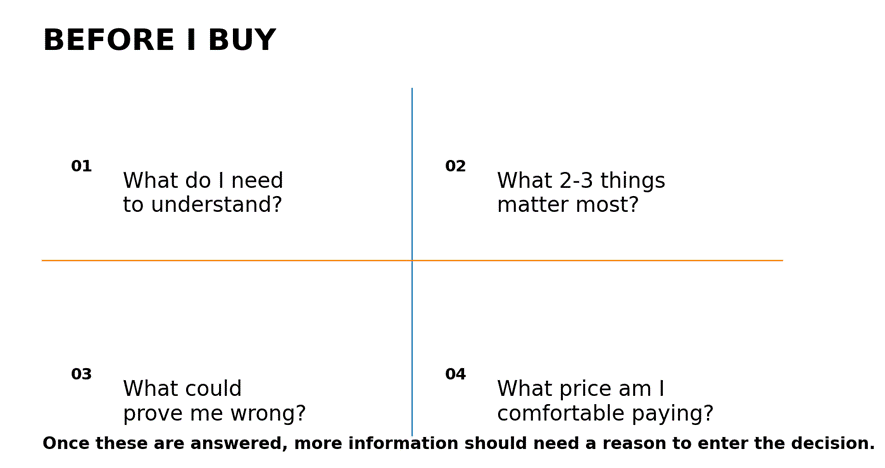
Before buying something, I would want to know four things. What do I actually need to understand about this business? What are the two or three things that will decide whether my thesis works? What could prove me wrong? And what price am I comfortable paying for the uncertainty that remains?
Once those questions are answered, every additional piece of information should have a reason to enter the decision.
Otherwise, research can quietly become a way of postponing the responsibility of making a choice.
Confidence was never supposed to mean certainty
I think this is where the whole conversation becomes easier.
We may be expecting information to give us something markets have never promised: certainty.
You can read every annual report, listen to every call, and build the best model in the room, and something you did not expect can still happen. A competitor can change the industry. Regulation can change. Management can make a mistake. Demand can disappear. A global event can change the assumptions behind your numbers.
That is investing.
So perhaps confidence should not mean: I have enough information to know what will happen.
A more useful form of confidence is: I know why I made this decision, I know what could prove me wrong, and I know what I will do if that happens.
When I started working in markets, good information was slower, more expensive, and much harder for a retail investor to access. Today, an investor sitting at home has company filings, screeners, conference calls, expert opinions, communities, historical data, and AI within reach.
That is a remarkable improvement.
But I don’t think the next generation of better investors will necessarily be the people who consume the most information.
It may be the people who become very good at deciding what to ignore.
Because the market will never give you enough information to remove uncertainty completely.
Perhaps confidence begins somewhere else: not when you finally know everything, but when you know what you need to know to make the decision.
Research note and sources.
SEBI percentages refer to surveyed investors in the Investor Survey 2025, full report published January 2026.
SEBI’s February 2026 speech on information asymmetry is used for the discussion of interpretation, biases, and information noise.
The psychology reference is Chernev, Bockenholt & Goodman, Choice overload: A conceptual review and meta-analysis, Journal of Consumer Psychology (2015), a meta-analysis of 99 observations involving 7,202 participants. Its findings are used here as a decision-making lens rather than direct evidence about Indian investing behaviour.