

What happens when a generation wants money to create freedom throughout life, while investing itself still demands patience?

By Rahul Ghose
For a long time, investing followed a fairly familiar life plan.
You started earning, saved some money, bought a house, provided for your family, and kept investing for retirement. If everything went reasonably well, by the time you reached your late fifties or sixties, you had built enough money to finally slow down.
I am not sure a 25-year-old today wants to wait that long to feel the benefit of having money.
Talk to younger people about why they want to invest, and retirement is still there. But so are things that happen much earlier. They want to travel and take a year away from work. Change careers or start something of their own or buy a house, perhaps, or simply reach a point where losing one job does not immediately become a financial crisis.
I find this interesting because it changes what we expect investing to do.
What does “RICH” mean at 30 now?
Think about two people earning roughly the same salary. One has a large home loan, a car EMI, and several other monthly commitments. The other has kept expenses lower and has been investing regularly for five or six years.
Now imagine both want to leave their jobs for six months. Suddenly, their salaries don’t tell us very much. One probably cannot afford to stop working. The other might be able to.
This is one way I think the meaning of being rich is changing. For someone in their twenties or thirties, feeling rich may have very little to do with owning an expensive house or car. It could simply mean knowing that you can survive for a year without a salary or that you can walk away from a job you hate or take a chance on a business without putting your entire life at risk.
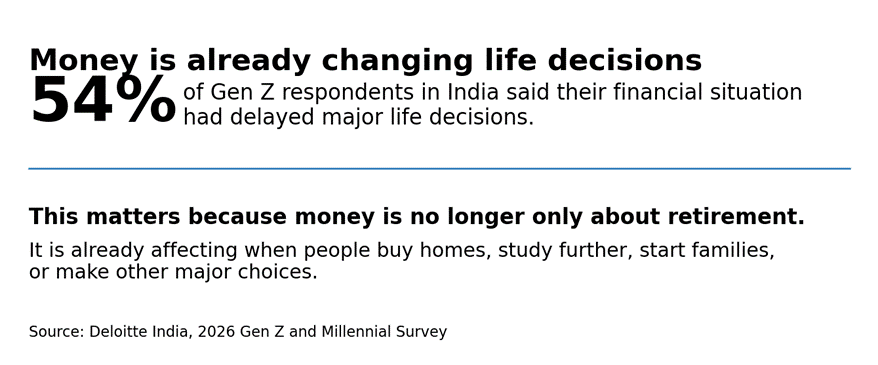
There is some evidence behind this thinking too. Deloitte’s 2026 India Gen Z and Millennial Survey found financial independence and work-life balance among the major priorities for young Indians. At the same time, 54% of Gen Z respondents said their financial situation had delayed major life decisions.
That tells me money is already connected to much more than retirement for this generation. It is connected to what they can do next.
One portfolio. Too many jobs.
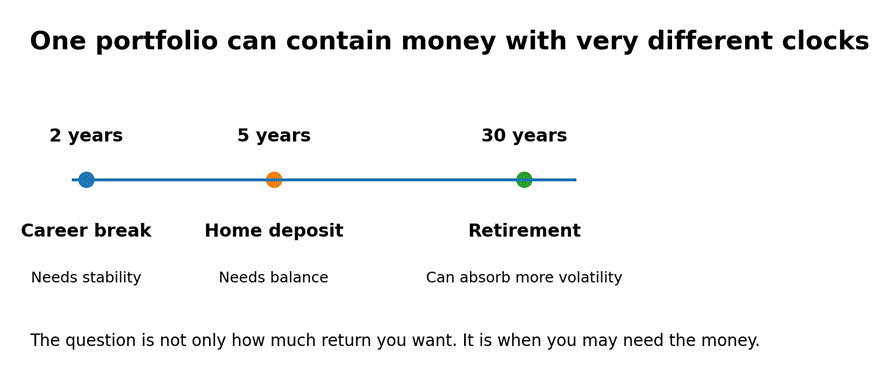
There is a problem, though. Suppose you are 27 and have Rs 10 lakh invested. Some of that money is for retirement. You will probably not touch it for another thirty years. But you also want Rs 3 lakh available because you may take a career break in two years. And perhaps you are thinking about a house five years from now.
Those three amounts cannot be treated in exactly the same way. If the market falls 30% tomorrow, the retirement money will have plenty of time to recover. The money you need two years from now may not.
This sounds obvious when you put it like this. Yet I see investors thinking about their entire portfolio as one number all the time. The question usually becomes: How much return can I make?
I think younger investors will increasingly have to ask another question first: when might I need this money? Because the moment you want your investments to give you freedom before retirement, liquidity starts to matter much more.
There is another problem Gen Z will have to deal with: speed
This is probably the part that interests me most. Almost everything about investing has become faster.
You can open an account in minutes. Transfer money instantly. Buy a stock from your phone. Check your portfolio twenty times a day if you want. A market event happens in America at night, and by breakfast, there are hundreds of videos explaining what you should do about it.
The stock market has not become faster just because access to it has.
Rs 10 lakh still needs time to become Rs 20 lakh without taking unreasonable risk. Businesses still need time to grow. Compounding still needs years.
And that creates a strange situation. The generation that wants financial freedom earlier is investing in an environment that constantly encourages it to expect results earlier too.
Those are two very different things. Starting at 23 instead of 33 is a huge advantage because you have ten additional years. Trying to force twenty years of returns into five years is something else entirely. That is usually where risk starts entering through the back door.
Financial independence can become another race
I like the idea of financial independence. But I also think we need to be careful about what happens when we attach an age to it.
“I want enough money to have choices” is a useful goal. “I need to be financially free by 30” can become a very different psychological problem.
Now imagine you are 28 and your target is Rs 1 crore by 30. You have Rs 35 lakh. A normal long-term return suddenly does not feel good enough. You start looking for something faster.
Perhaps you increase your exposure to a sector that has already gone up sharply. Perhaps you start trading. Perhaps somebody online tells you about an asset that can double. You see another 29-year-old talking about reaching heights and begin wondering whether you are behind.
Nothing about the market has changed. Your deadline has changed the way you look at the market.
I have seen versions of this behaviour for years. The target may be different, but the psychology is familiar. Once investors decide they need a certain return, they become much more willing to believe stories that promise it. That is where a goal that began with freedom can slowly create pressure.
The good news is that Gen Z has something previous generations did not
Time.
If someone begins investing seriously at 23 or 25, they do not need to get everything right immediately. They have time to make mistakes. Time to understand what kind of volatility they can actually handle. Time to increase their income. Time to let compounding do the boring work.
The access is also extraordinary compared with even fifteen years ago. A young investor can start a SIP from a phone, buy an index fund, invest small amounts, learn about markets, and see exactly where the money is going. Information that once required a broker, adviser, or finance newspaper is available in seconds.
SEBI’s Investor Survey 2025 also shows how important younger investors are to the next wave of market participation: Gen Z made up 56% of people in the survey who were aware of securities-market products and intended to invest within the next 12 months.
But easy access does not automatically make someone a better investor. Sometimes it simply makes it easier to act, and markets have a habit of rewarding people for doing very little for long periods of time. That may be one of the harder lessons for a generation used to immediate feedback.
So is the purpose of investing changing?
I think it is becoming wider.
Retirement still matters. Buying a home still matters. Family security still matters. But a 27-year-old may also want money to make their thirties better, not only their sixties.
I don’t think there is anything wrong with that. In fact, there is something sensible about asking why all the freedom created by decades of saving should arrive only towards the end of your working life.
The difficult part is getting the balance right. Spend everything on experiences today, and your future self pays for it. Lock everything away for forty years, and you may discover that you built a very secure future while giving yourself very little room in the present.
Investing has always involved balancing today against tomorrow. Gen Z is simply asking for a little more from today.
After spending years around markets, I think this will be one of the more interesting changes to watch. Younger investors have better access, they are starting earlier, and many of them are thinking about money much sooner than previous generations did.
But the market will still ask the same thing from them that it has asked from every generation before them.
Time.
Perhaps the real challenge for Gen Z is not figuring out how to become rich before 60. It is figuring out how to use money to live earlier without asking their investments to grow faster than investing actually works.
Research note: The data points are used to frame the behavioural argument, not to describe every Gen Z investor. Deloitte India’s 2026 survey covered 506 Gen Z respondents in India. The SEBI figure refers specifically to surveyed non-investors who were aware of securities-market products and intended to invest within the next 12 months.
Sources: Deloitte India, 2026 Gen Z and Millennial Survey; Securities and Exchange Board of India (SEBI), Investor Survey 2025, published January 2026.