

Or Have We Misunderstood What Risk Means to Women Investors All Along?

For years, women have been described as conservative investors. There is enough evidence to make that description sound reasonable. SEBI’s Investor Survey 2025 found that 82% of women preferred low-risk investments, compared with 78% of men. If that were the only number available, there would be little reason to question the conventional view.
But then look at what women are actually doing with their money.
Among women under 25, 88.3% of mutual fund assets are invested in equity funds. Among women aged 25 to 44, the proportion is 76.2%. Even among women aged 45 to 58, nearly two-thirds of mutual-fund assets remain in equity.
Those numbers made me pause because they do not fit neatly with the idea of the risk-averse woman investor. How does someone say she prefers low risk while putting a large part of her long-term investment portfolio into an asset class that can easily fall 20 or 30%?
Perhaps there is no contradiction.
Perhaps we have spent years asking whether women are willing to take risks when the more interesting question is what women consider a risk in the first place.
The saver was already managing risk
For generations, women have been central to the way Indian households saved money. Small amounts were kept aside from monthly budgets. Cash found its way into cupboards, envelopes, and steel boxes. Gold accumulated over years. Fixed deposits offered certainty. Money was earmarked for education, weddings, medical emergencies, or simply for a year when household income might come under pressure.
It would be wrong to romanticise this history. Much of this behaviour developed during a period when women had limited access to formal financial products and, in many households, limited control over larger financial decisions.
But there was also an instinct underneath these choices that is worth understanding. The first job of money was often to make sure that when something went wrong, some money survived.
That is not necessarily an aversion to risk. It is a way of managing it.
The financial system surrounding that instinct has changed dramatically. The steel box became a bank account. The bank account got connected to a phone. The phone opened access to mutual funds, equities, ETFs, and demat accounts.
Women’s demat account openings have risen 129% since 2021, according to the Axis Direct data used for this article. By March 2026, around 1.61 crore women were part of India’s 6.09 crore mutual-fund investor base, and women’s mutual-fund assets had grown from Rs.5.84 lakh crore in March 2021 to Rs.15.88 lakh crore in March 2026.
The size of that growth is impressive. But I find what happened inside those portfolios much more interesting than the number of accounts that were opened.
We may be confusing risk with volatility
When someone says, “I do not like risk,” what exactly does that mean?
Financial markets tend to put several very different possibilities under the same word. A stock falling 25% is considered a risk. Investing in a business that permanently destroys your capital is also a risk. Keeping all your money in supposedly safe assets while inflation slowly reduces its purchasing power creates another kind of risk. So does locking away money that you may urgently need two years from now.
These risks are not the same, financially or psychologically.
Consider a young woman who keeps six months of expenses safely in the bank but invests most of the money meant for retirement through equity mutual funds. If the market falls 25%, she may be perfectly willing to wait because that money has a twenty-year job.
Ask her whether she considers herself a risk-taker, though, and she may still say no.
There is nothing inconsistent about that answer.
She may be extremely cautious about losing money permanently while being comfortable with temporary volatility. She may refuse to speculate on something she does not understand but willingly watch an equity SIP fluctuate for fifteen years. She may protect the money needed tomorrow while taking a substantial risk with money meant for much later.
This is why the description of women as simply “risk-averse” starts becoming less useful.
Being careful about risk is not the same as refusing to take it.
The same market fall can become a different risk with age
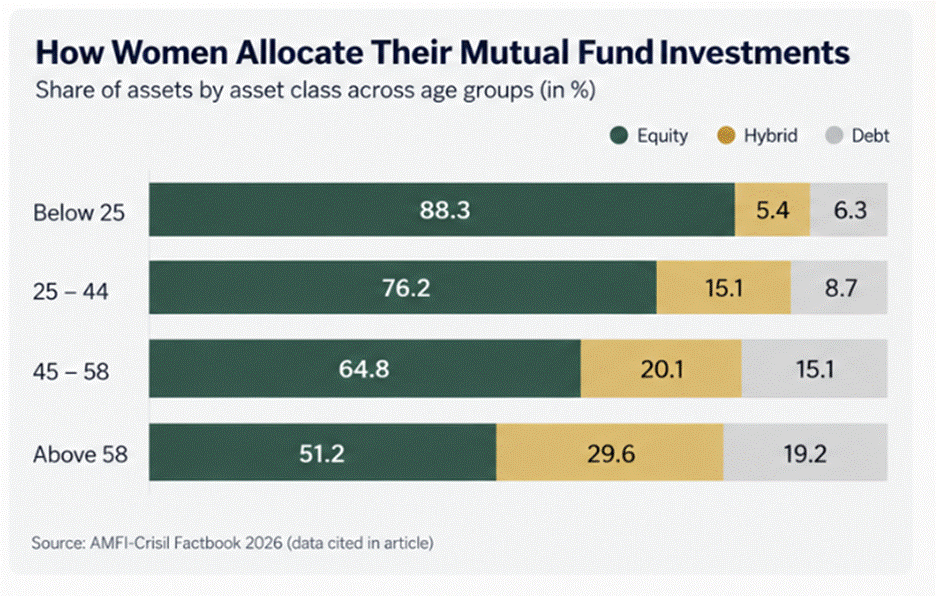
The age-wise allocation data makes this distinction clearer.
Equity accounts for 88.3% of mutual-fund assets among women below 25 and gradually falls to 51.2% among women above 58. At the same time, hybrid allocation rises from 5.4% among the youngest group to 29.6% among women above 58, while debt becomes more meaningful in the oldest group.
The easy conclusion is that women become more conservative as they grow older.
I think time may explain more than age itself.
Imagine two women watching their equity portfolios fall 25% during the same market correction. One is 27 and investing for a goal twenty years away. The other is 60 and expects to use part of that money within the next three years.
The market has given both investors exactly the same return.
Their risk is completely different.
The first investor has time to wait for the market cycle to play out, assuming the underlying investments remain sound. The second may have to withdraw capital before that recovery happens. For her, volatility is no longer simply something happening on a screen. It can interfere with an actual financial need.
Seen this way, the movement towards hybrid funds and debt as women grow older does not necessarily indicate increasing fear. It can indicate something far more rational: the investor’s ability to absorb volatility has changed.
Good investing is not about taking the maximum possible risk. It is about taking risks that your finances, goals, and time horizon give you the ability to survive.
Gold changed its form. Did its psychological role change?
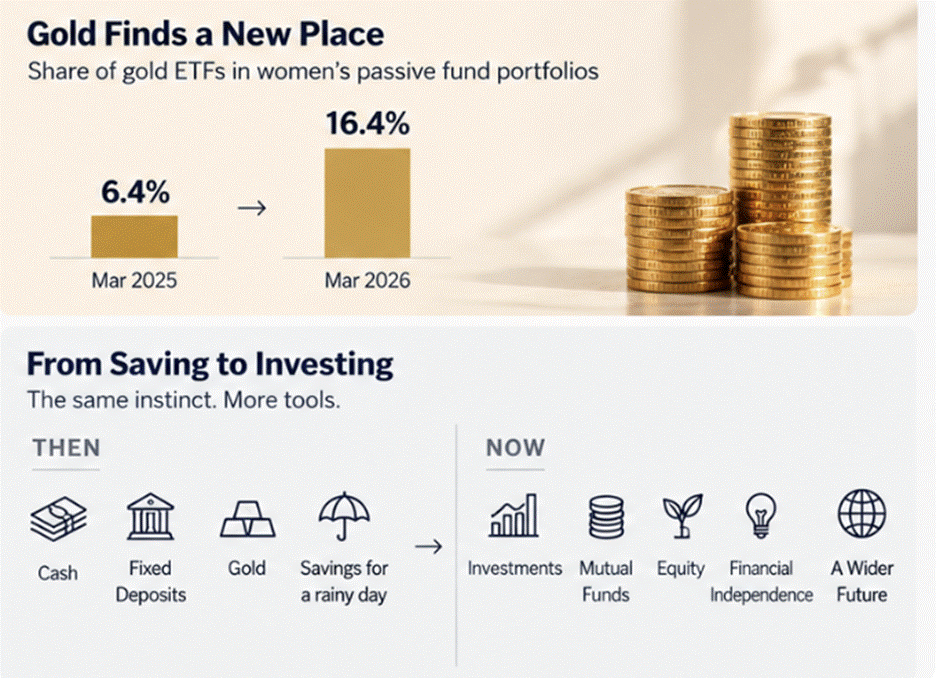
Gold adds another interesting layer because Indian women never needed financial markets to introduce them to it.
For generations, jewellery was more than something worn on an occasion. It also represented stored wealth, emergency capital, and an asset that could be held through periods of uncertainty.
Today, part of that behaviour is appearing in a different form. Gold ETFs represented 6.4% of women’s passive-fund portfolios in March 2025. By March 2026, the figure had increased to 16.4%. The broader surge in gold was certainly not limited to women; precious-metal prices and global uncertainty increased investor interest across the market.
But the psychological continuity is interesting.
A grandmother accumulating jewellery and her granddaughter buying units of a gold ETF appear to be making very different financial decisions. Yet part of the instinct underneath those decisions may be familiar: keep some wealth in an asset expected to provide protection when other things become uncertain.
The instrument changed. The financial system changed. The instinct adapted.
Modern financial products do not always create entirely new investor behaviour. Sometimes they give an old financial instinct a more efficient way to express itself.
What a portfolio tells us is that an account cannot
This is why I would pay less attention to another record in women’s demat account openings and more attention to what happens after those accounts are opened.
An account tells us that someone has entered the market. A portfolio tells us how that person thinks about money.
The portfolios emerging from the latest data do not show women simply abandoning safety and embracing risk. Instead, different assets appear to be taking on different responsibilities. Equity can provide long-term growth. Hybrid funds and debt can become more important as the time available to recover from volatility shortens. Gold can provide a different form of protection.
That is a much more mature financial transition than moving from “saver” to “investor.”
It is a movement from thinking about individual products to thinking about what each part of your money needs to do.
For decades, household financial decisions were often separated into categories. A fixed deposit was for safety. Gold was security. Insurance was protection. Property was wealth.
Once those assets begin sitting within a broader portfolio, the question changes. Instead of asking which product is safe and which product is risky, the investor can ask: What risk am I taking here, and why am I taking it?
That is a far more useful question.
THE CLOSING
For years, we have tried to understand women investors by asking how much risk they are willing to take.
I am beginning to think that is the wrong question.
Every financial choice contains some form of risk. Holding too much cash carries inflation risk. Equity carries market risk. Concentrating wealth in one asset creates another risk. Avoiding volatility can protect you today while making it harder for your money to compound tomorrow.
The real decision is which of those risks you understand, which ones you can afford, and which ones you are willing to live with.
That is what I find most interesting about the changing portfolios of Indian women.
The woman who once kept money aside for an uncertain year and the woman who today divides her investments between equity, debt, and gold may have more in common than we assume. The products available to her have changed dramatically. Her ability to express different financial needs through those products has changed even more.
Perhaps women were never avoiding risk as much as we thought. They were deciding which risks were worth taking.