

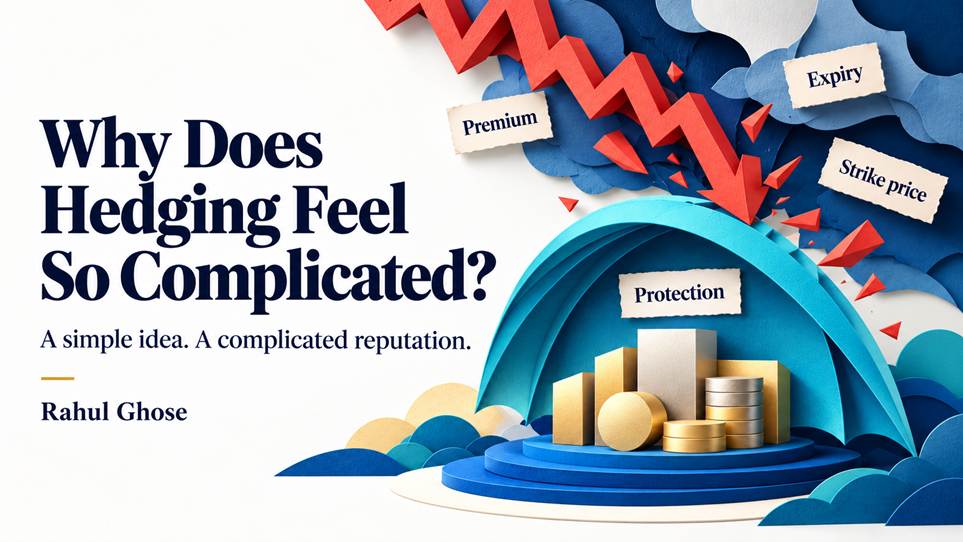
Most investors already understand protection. The difficulty begins when that familiar instinct enters the stock market and gets buried under the language of derivatives.
Rahul Ghose
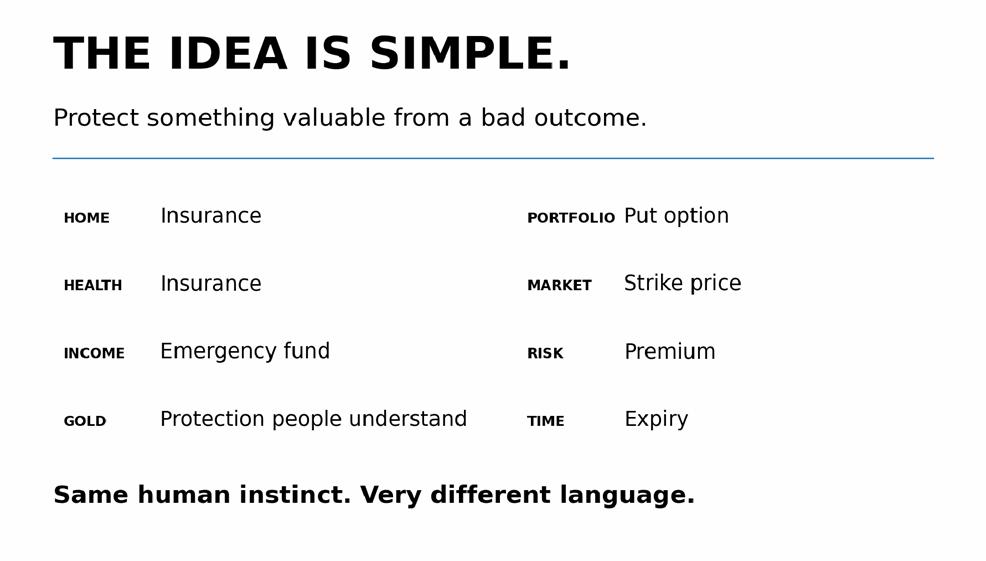
If you own a house, buying insurance does not mean you expect the house to burn down. If you keep six months of expenses in an emergency fund, it does not mean you expect to lose your job next month.
And when Indian families buy gold because they want something that may hold up when other things are uncertain, nobody needs a lesson on portfolio theory before the idea makes sense.
We understand protection quite naturally in most parts of life. Then we enter the stock market and call the same instinct hedging.
Suddenly there are puts, calls, strike prices, premiums, expiries, Greeks, implied volatility and payoff charts. A very ordinary human idea starts sounding like something that belongs on a professional trading desk.
I have always found that strange because the basic question behind a hedge can be very simple: I want to remain invested, but how much damage am I willing to accept if things go badly?
What hedging actually means
Hedging means taking another investment position designed to offset some of the loss if something you already own falls in value. In plain language, you keep the investment and add a way to soften a bad outcome.
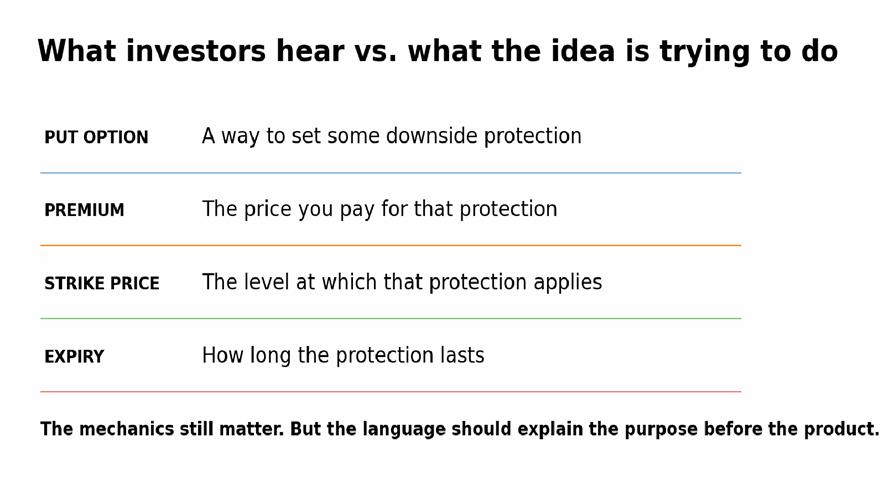
A put option is one way to do this. Think of it as paying for the right to sell your shares at a price you choose in advance, even if their market price falls below that level. You pay a fee, called a premium, for this protection. It lasts only until a specified date. This is one form of hedging; other methods work differently.
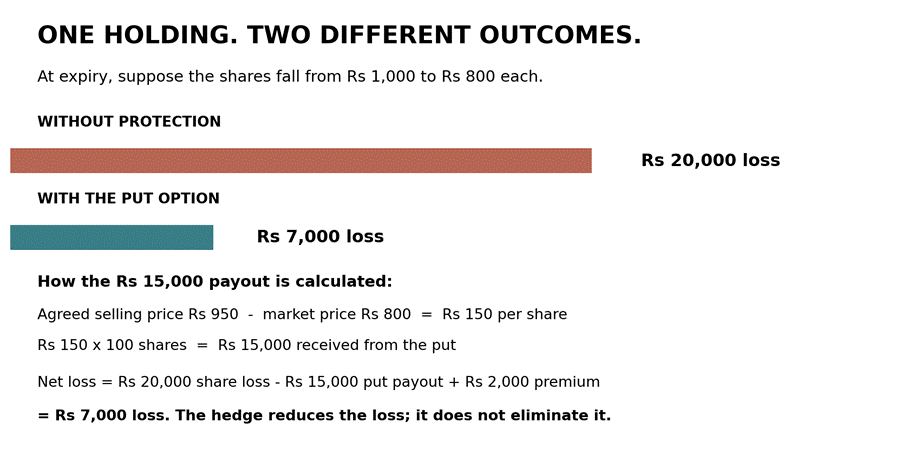
Consider a hypothetical example. You own 100 shares bought at Rs 1,000 each, so you have invested Rs 1,00,000. You are worried that their price could fall over the next few months, but you want to keep holding them. You therefore buy a put option that covers exactly those 100 shares. It gives you the right to sell them for Rs 950 each at expiry, even if the market price is lower. This protection costs Rs 2,000 in total. The Rs 950 level is the agreed selling price, and the Rs 2,000 is the premium you pay.
If the shares rise or stay flat
The put may expire unused. You still benefit from a rise in the shares, but the Rs 2,000 premium reduces your return. Protection has a cost even when you do not need to use it.
| Share price at expiry | Without the put | With the put, after premium |
| Rs 800 | Rs 20,000 loss | Rs 7,000 loss |
| Rs 1,000 | No gain or loss | Rs 2,000 loss |
| Rs 1,100 | Rs 10,000 gain | Rs 8,000 gain |
Illustration only. Hypothetical prices and premium; outcomes are at expiry, measured against the initial share value, with the premium included once. Fees and taxes are excluded. The put exactly matches the shares and quantity held. A hedge on a broad index may not move in step with a different portfolio. Protection also has a time limit.
Source for the protective put explanation: Cboe, Portfolio Protection https://www.cboe.com/us/index_protection/
Maybe hedging has a language problem before it has an investing problem
Think about gold for a moment.
An investor may buy gold because equity markets feel uncertain, inflation worries them, or they simply want part of their wealth in something different. They may never use the word correlation. They may never calculate portfolio beta. They may not know exactly how gold will behave during the next correction.
The idea still feels understandable: I don’t want everything I own depending on the same outcome.
Now tell the same investor that there are ways to protect an equity portfolio using derivatives, and the conversation changes immediately. The product arrives before the purpose. We start explaining contracts before explaining what problem the contract is supposed to solve.
That matters psychologically. People are much more comfortable with a risk they can picture than with a mechanism they have to decode.
A gold coin is visible. An insurance policy has a familiar story behind it. A put option is a contract with a strike price and an expiry date. Even before the investor decides whether it is useful, the language has already told them: this is complicated.
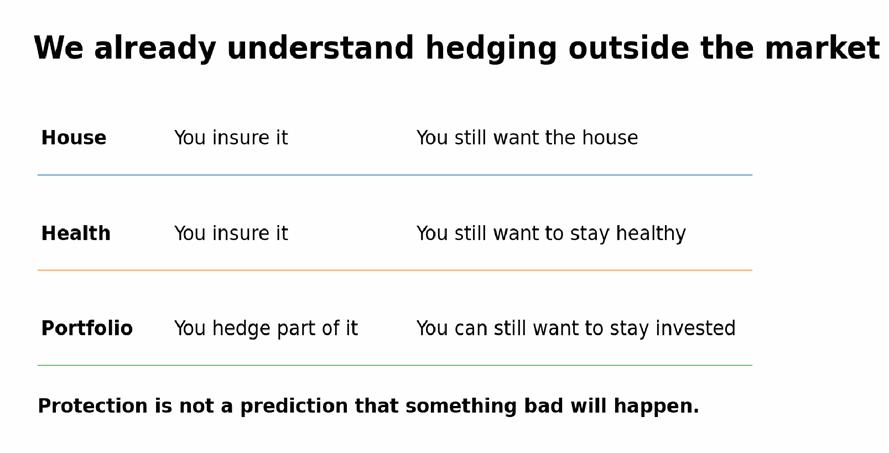
Protection is already familiar to investors. The market changes the vocabulary.
Derivatives also became associated with the opposite of protection
There is another reason hedging feels harder than it should.
For many retail investors, their first introduction to derivatives has very little to do with hedging. It is trading.
Options are discussed through weekly expiry, quick profits, leverage, trading strategies and screenshots of returns. That is a very different psychological frame from protection.
The numbers show how strong that association has become. SEBI’s FY25-FY26 study found that 99.3% of individuals participating in the equity derivatives segment traded options at least once, and 93% traded only options. It also found that about 35% of derivatives traders had no underlying equity portfolio at the end of FY26.
That last number is particularly interesting to me. If someone is using derivatives without an underlying equity portfolio, whatever they are doing may be perfectly legitimate trading, but it is difficult to describe it as protecting that equity portfolio.
SEBI also found that 87.7% of individual derivatives traders lost money in FY26, and options accounted for 92% of aggregate individual losses. These numbers are an important warning about speculative derivatives trading. They also help explain why the words options and F&O; can immediately sound dangerous to a retail investor.
The instrument that can be used to reduce one kind of portfolio risk has become mentally associated with taking more risk.
“The instrument that can reduce one kind of portfolio risk has become mentally associated with taking more risk.”
We may also be uncomfortable paying for something we hope never pays us back
This is the part of hedging psychology I think deserves more attention.
Suppose you pay for protection and the market rises. Your portfolio does well. The hedge may expire unused, and the money spent on it can feel wasted. That feeling is familiar outside investing too. Nobody celebrates paying an insurance premium for ten years and never making a claim. Yet we understand that the absence of a claim does not mean the insurance had no purpose.
In markets, the calculation feels harsher because we can see the cost next to our returns. If I spend money protecting a portfolio and the market keeps rising, I can calculate exactly how much more I would have made without the hedge.
This creates a strange temptation. We judge protection using the outcome that happened rather than the risk that existed when we bought it.
A hedge can look unnecessary precisely because the bad outcome did not arrive.
That does not mean every investor should constantly buy protection. Hedging has a cost, and poorly designed hedges can reduce returns or create risks of their own. The point is that the cost should be judged against the problem the investor was trying to solve, not simply against what the market happened to do afterwards.
The real question is not, “Do I think the market will fall?”
I think this is where many conversations about hedging begin in the wrong place. Someone asks whether the market is going to fall. If the answer is yes, they think about protection. If the answer is no, they stay fully exposed.
But that turns hedging into a forecasting exercise.
You don’t insure your house because you have predicted a fire. You insure it because the consequence of a fire would matter to you.
Portfolio protection can be thought about in the same way.
Perhaps you have built a large equity portfolio over fifteen years and do not want to sell it because you still believe in the businesses you own. But you are approaching a point when some of that money may be needed. Or perhaps one part of the portfolio has become much larger than you intended. Or you simply know that a severe fall would make you panic and sell at the worst possible time.
Now the question becomes much more useful: What happens to me if the market falls badly?
That is different from asking whether it will fall.
Simple does not mean risk-free
I also don’t want to make the opposite mistake and pretend derivatives themselves are simple products.
They are not.
Time to expiry matters, volatility matters, level of protection matters, and liquidity matters. The price you pay matters. Leverage can magnify losses very quickly when derivatives are used for speculation rather than protection. SEBI explicitly warns investors about these risks.
So simplifying hedging should never mean hiding the mechanics. It should mean teaching them in the right order.
Start with the portfolio. What are you trying to protect? From what kind of loss? For how long? How much protection do you actually need? What are you willing to pay for it?
Only then should we talk about the instrument.
Instead, retail investors are often introduced to the instrument first and expected to reverse-engineer the purpose later. No wonder it feels complicated.
I think hedging needs to become a normal portfolio conversation
For years, retail investing has become easier.
Opening an account became easier. Buying a stock became easier. Starting a SIP became easier. Seeing your portfolio became easier. Information became easier to access.
Protection has not gone through the same simplification. That is important because the Indian retail investor is becoming more involved in markets, while derivatives are already deeply present in that same ecosystem. The answer cannot be to pretend these instruments do not exist. Nor should the answer be to make everyone an options trader.
The opportunity is to separate using derivatives to take a view from using them to manage an existing risk. Those are different conversations, even if some of the instruments are the same.
After spending years around markets, this is one reason I have remained interested in hedging. The idea itself has never seemed exotic to me. We hedge things throughout our lives. We protect our homes, our health, our income, and our families from outcomes we hope never happen.
A portfolio is one of the few valuable things where we still behave as though protection needs to be understood only by experts.
Maybe the next step in retail investing is not another way to buy faster. Maybe it is finally learning how to talk about protection in a language investors already understand.
Research note and sources. The derivatives’ participation and profitability figures are from SEBI’s August 2026 studies on individual traders in the Equity Derivatives Segment. SEBI reported that 87.7% of individual derivatives traders were loss-makers in FY26, options accounted for 92% of aggregate individual losses, 99.3% of individuals in the segment traded options at least once, 93% traded only options, and about 35% of FY25-FY26 derivatives traders had no underlying equity portfolio at the end of FY26. SEBI’s investor education material is used for the discussion of leverage, market, liquidity, operational and counterparty risks. These statistics describe derivatives participation and trading outcomes; they do not measure the effectiveness of hedging strategies specifically.