

The ₹100 Dream That’s Reshaping Indian Markets
Walk into any trading floor today, and you’ll hear the same story repeated dozens of times: “I bought this option for ₹100, and it went to ₹800 in two hours.” What you won’t hear as often are the twenty other ₹100 trades that went to zero.
This isn’t just another story about retail traders getting lucky or going broke. It’s about something much bigger happening in Indian markets right now, a fundamental shift in who’s trading options and why. And if you’re managing money or advising clients, you need to understand this phenomenon because it’s creating opportunities and risks that didn’t exist five years ago.
Why Everyone’s Suddenly an Options Expert
The math seems simple enough. Put down ₹100, maybe make ₹1,000. Risk is limited, upside is huge. What’s not to love?
Here’s what’s really happening in traders’ minds: they’re not seeing this as a 90% chance of losing ₹100. They’re seeing it as a 10% chance of making ₹900. Same trade, completely different mental framing. And that difference explains why options trading has exploded among retail investors.
The Psychology That Hooks Everyone
Let me tell you why this ₹100 trade is so psychologically powerful, it’s like a perfect storm of human behavioral biases.
The “Small Loss, Big Win” Trap: Your brain is wired to think ₹100 is “throwaway money.” It’s less than a decent snack out. But ₹1,000? That feels life-changing. This creates what psychologists call “loss aversion imbalance”, we don’t fear small losses as much as we should, but we overvalue large potential gains.
The Social Media Effect: Every day, someone posts a screenshot of their ₹100 becoming ₹2,000. Your brain sees this and thinks, “That could be me.” What you don’t see are the 50 people who lost ₹100 the same day, they don’t post screenshots of their losses. This creates a completely distorted view of how often these trades actually work.
The “Near Miss” Addiction: This is the most dangerous part. Say you buy an option for ₹100, and the stock moves 90% of the way you need it to move, but your option still expires worthless. Your brain doesn’t register this as a complete failure, it registers it as “almost winning.” This near-miss feeling is incredibly addictive and keeps people coming back.
The Complexity Illusion: Options feel sophisticated. You’re not just buying stocks like everyone else, you’re trading derivatives, using Greeks, understanding volatility. This makes people feel smarter and more professional, even when they’re essentially gambling.
The “Hot Hand” Fallacy: Win once or twice, and suddenly you think you’ve figured out the system. Your brain tricks you into believing you have skill when it was really just luck. This is why beginners often blow up their accounts after a few early wins, they start betting bigger, thinking they’ve cracked the code.
The Numbers Tell the Story
Between FY22 and FY25, retail investors lost ₹2.85 lakh crore in options trading. FY25 alone saw ₹1.05 lakh crore in losses.
Meanwhile, FPIs and proprietary desks booked steady profits: ₹28,000 crore and ₹33,000 crore in FY24, with over 95% of those profits powered by algorithms.
The lesson is stark: retail’s ₹100 bets are systematically funding professional traders.
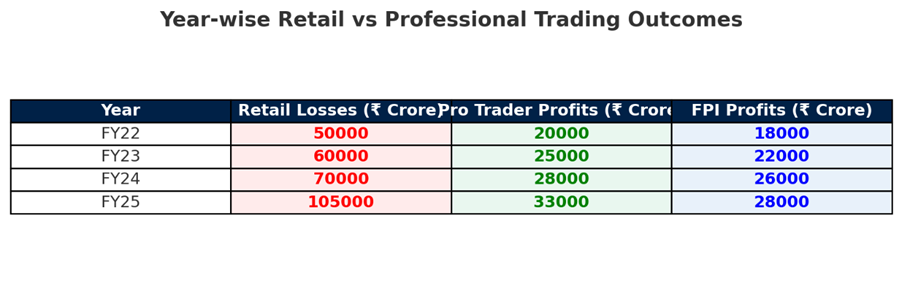
The picture is clear: sophisticated algorithmic traders are systematically extracting wealth from retail traders who think they can compete using mobile apps and YouTube tips.
Time Decay: The Silent Killer
This is where things get really interesting, and where most retail traders get caught off guard. Every option has an invisible timer ticking down, eating away at its value every single day. We call it time decay, but I prefer to think of it as a “melting ice cube.”
Imagine you buy an ice cube for ₹100. Every day, it gets smaller. Even if the weather stays exactly the same, your ice cube is worth less tomorrow than today. By the time a week passes, there might be nothing left.
Options work the same way. That ₹100 option doesn’t just need the stock to move in your favor, it needs to move fast enough to overcome the daily value erosion. And here’s the kicker: the erosion accelerates as expiry approaches.
I’ve seen traders buy options on Monday for ₹100, watch the stock move exactly as they predicted, and still lose money by Friday because time decay ate up more value than the stock movement created. It’s brutal, and it’s mathematical.
The Weekly Expiry Casino
The introduction of weekly options has turbocharged this entire phenomenon. Now traders don’t have to wait a month to see their ₹100 either multiply or vanish—they can get that thrill every week.
From a market structure perspective, this creates some fascinating dynamics. Every Thursday and Friday, you see massive volatility as weekly options approach expiry. Stocks start behaving strangely, drawn toward certain price levels like magnets. Professional traders call this “pinning,” and we’ve learned to position around it.
What’s happening is that retail traders’ collective ₹100 bets are actually moving stock prices. The dealers who sell these options need to hedge their positions, which creates buying and selling pressure at specific price levels. It’s like watching thousands of small trades collectively move large-cap stocks.
Smart institutional money has figured this out. They’re positioning ahead of these predictable patterns, essentially profiting from the collective behavior of retail options traders.
Who Should Actually Be Trading Options (And Who Should Run Away)
Here’s the uncomfortable truth: most people trading options shouldn’t be. Let me break this down clearly.
You Should NOT Trade Options If:
- You’re using money you need: If losing ₹10,000-20,000 would affect your rent, EMIs, or family expenses, stay away. SEBI data shows 75% of F&O traders earn less than ₹5 lakh annually, yet average losses are ₹2 lakh over three years. That’s nearly half their annual income gone to options trading.
- You think it’s an investment: Options are speculation, not investment. Only 7% of traders made any profit over three years, and just 1% made profits exceeding ₹1 lakh after transaction costs. If you’re looking to build wealth systematically, stick to mutual funds and stocks.
- You’re emotionally driven: The SEBI study shows that 75% of loss-making traders continued trading despite consecutive years of losses. If you trade when angry about losses or trying to “get even,” you’ll likely join this statistic.
- You don’t understand the house edge: This isn’t a level playing field. While retail traders lose ₹1.8 lakh crore, algorithmic traders made 97% of all F&O profits. You’re not just betting against the market, you’re betting against supercomputers.
- You’re young and inexperienced: The data shows 43% of F&O traders are under 30, and 93% of young traders lost money in FY24—even higher than the overall loss rate of 91%. Youth and enthusiasm don’t overcome mathematical disadvantages.
Practical Guidance for Those Still Interested
If you choose to trade options, do so wisely:
- Risk Only What You Can Afford to Lose: Treat options trading like entertainment, not income.
- Adopt Risk Management: Use strict limits on how much you bet per trade; consider stop-loss techniques and position-sizing rules.
- Learn Before You Leap: Utilize virtual trading platforms or paper trade to grasp market dynamics without risking capital.
- Understand Time Decay and Greeks: Deepen your knowledge of volatility, time decay, and option Greeks to make informed decisions.
- Be Disciplined and Emotional Resistance: Avoid impulsive trades motivated by frustration or “getting even.”
- Integrate Options into a Broader Portfolio: Use options as a strategic tool alongside more traditional investments rather than relying on them exclusively.
The Bottom Line
The ₹100 options trade isn’t going anywhere. The appeal of limited downside with unlimited upside is too powerful. But the traders who survive and thrive will be those who understand what they’re really buying: not a lottery ticket, but a sophisticated financial instrument with specific mathematical properties.
The winners won’t be those who get lucky once or twice. They’ll be those who understand the odds, manage their risk, and treat options as one tool in a broader investment toolkit rather than a get-rich-quick scheme.
As markets continue to evolve, one thing remains constant: understanding both the mathematics and psychology of trading is what separates long-term success from short-term luck
Options trading involves substantial risk and may result in loss of invested capital. Past performance does not guarantee future results.