
With global shocks rising and younger investors taking larger risks, protection must become the core design principle.
India’s investor base has changed more in the last decade than in the previous three combined. You can see it in the numbers: demat accounts have grown from 2.1 crore in 2014 to more than 12 crore today. You can see it in the age profile: a large share of new investors are Gen Zs and young millennials, entering the markets through equities, SIPs, and increasingly through F&O. And you can feel it in the conversations happening around you , people who once spoke only about salary growth now speak about compounding, portfolios, and financial independence.
This is progress. But it is incomplete progress.
The environment these new investors are entering is fundamentally more demanding than what previous generations faced. Global shocks reach India within hours. Cycles turn sharply. Volatility can erase months of optimism in a few trading sessions. And most young investors , despite their enthusiasm , are stepping into the market with exposure levels that previous generations rarely carried at the start of their journey.
Participation has grown fast; the tools that protect participants have not. That is the context behind this article. It is broken into two parts.
The first explains the landscape investors are entering today.
The second outlines the tools, assessments, and protection-first systems that will define the next decade , and why they have not been built yet.
The goal is simple: to understand where India stands, and what must change for investors to stay invested long enough to benefit from what the markets can truly offer.
Part 1: The Landscape Investors Are Entering Today
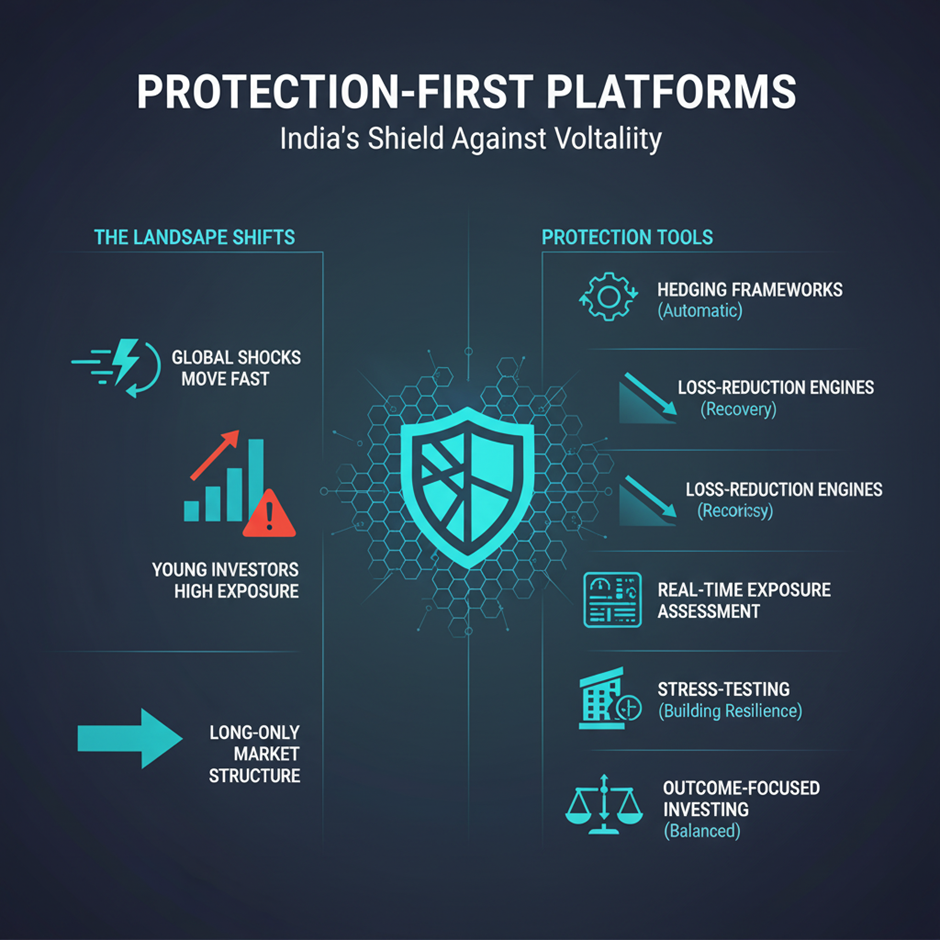
Three shifts define India’s new investing environment , and they are reshaping investor behaviour faster than the industry expected.
1. Global shocks now move through the system in hours, not weeks
Over the last few years, Indian markets have reacted almost instantly to events happening thousands of miles away:
- pandemic-driven sell-offs
- geopolitical tensions
- bank failures abroad
- bond-market reversals
- short-seller reports
- sudden liquidity shifts
The data confirms what investors feel. A 2023 SEBI study showed that correlation between Indian and global equity indices has increased from 0.42 in 2010 to 0.68 in 2023. The buffer that once insulated India , regulatory friction, information lag, slower capital flows , has largely disappeared.
This speed demands a level of risk preparedness most investors do not yet have.
2. Younger investors are entering with more enthusiasm and more exposure
The rise in participation is encouraging, but the profile of the new investor is different.
NSE data shows F&O participation among retail investors has grown 400% since 2019. Many carry leveraged positions early in their journey, react quickly to news cycles, and learn about markets through fragmented short-form content. They are ambitious, fast, and eager , but often without the guardrails that match their risk.
3. India remains a long-only market in a world that moves both ways
Mutual funds, ETFs, PMS models, and direct equity portfolios depend almost entirely on upward movement. When markets fall, portfolios absorb the full decline. This structure works during steady periods, but it magnifies emotional stress during corrections , leading to rushed exits and long recovery periods.
AMFI data shows that during the March 2020 crash, SIP discontinuation rates spiked to 38%. Most investors exited near the bottom.
These three shifts , faster shocks, younger high-exposure participation, and long-only structures , have created a gap between how the market behaves and how investors are protected. That gap will define who survives the next decade of Indian investing.
This is why the industry must move beyond “access” and adopt systems that help investors withstand volatility without losing confidence.
Part 2: The Tools And Assessments That Will Define A Protection-First Decade
The question is not whether these tools should exist. The question is: why do they not exist yet?
The answer is straightforward. Complexity, cost, and regulatory clarity.
Hedging tools have historically been complicated, expensive to execute at scale, and limited by regulatory frameworks designed for institutional players. But technology is changing. Transaction costs are dropping. And regulations are evolving.
Here is what the next generation of investor protection will look like , and what is making it possible now.
A. Built-in hedging frameworks will become foundational
For years, hedging was treated as something only traders understood. In reality, it is the seatbelt of modern investing. A simple example shows why: If your portfolio falls 20%, a small hedge falling only 5% helps offset part of the damage. You do not eliminate the fall, but you soften the blow , and that softening is what prevents panic exits.
Imagine an investment product where, whenever your exposure crosses a certain threshold, the system automatically creates a protective layer using simple, liquid instruments. You do not have to understand derivatives. You do not have to “time” anything. The system quietly reduces the impact of sudden declines.
This is what hedging will look like for everyday investors: invisible, automated, and always present.
Why this has not happened yet: Building automated hedging at scale requires sophisticated risk engines, real-time position monitoring, and regulatory approval for retail-accessible derivative strategies.
What changes now: Lower F&O transaction costs, improved API infrastructure from exchanges, and SEBI’s recent consultation papers on retail derivative access are creating the conditions for this to scale.
B. Loss-reduction engines will help investors manage damage after it begins
This is one of the biggest gaps in today’s platforms. If an investor is sitting on a position that is down 30%, the industry offers only three options: hold, exit, or hope.
But the next decade will bring structured tools that look more like this: The system analyses your losing position, identifies whether the stock is stabilising or weakening, and suggests structured actions: partial exits, protective options, or converting the position into a lower-risk version of itself.
For example: If a stock has dropped sharply but the business remains intact, the engine might recommend turning it into a “covered” position so the investor earns back part of the drawdown through income.
If the business is weakening, the engine might suggest a controlled exit path rather than a panic sell. This is not theory. This is what institutional trading floors do every day. For the first time, it will reach everyday investors.
Why this has not happened yet: Building these engines requires combining fundamental analysis, technical indicators, options pricing models, and behavioural psychology , all in real-time. It is technically feasible but resource-intensive.
What changes now: Advances in AI-driven portfolio analytics and increasing retail adoption of options (NSE options turnover is up 12x since 2019) create both the capability and the demand.
C. Real-time exposure and risk assessment will become essential
Most investors know the names of the stocks they own. Very few know what their exposure truly means. Real risk assessment tools will show:
- You think you have five stocks. But they all behave like one sector.
- You think your portfolio is balanced. But 70% moves with global volatility.
- You think your position is small. But leverage magnifies it five times.
These assessments will act like a weather forecast: “Your portfolio is entering a high-volatility zone. Here is the protection you need.” “Your exposure is concentrated. Here is how to rebalance before stress hits.”
Today, investors feel risk only when the loss shows up. Tomorrow, they will see risk before it becomes a loss.
Why this has not happened yet: Most platforms optimize for ease of trading, not risk transparency. If investors saw real risk, they would trade less. But brokerages make money from trades, so they avoid showing it
What changes now: Subscription-based revenue models reduce the reliance on transaction fees, aligning incentives toward long-term investor success.
D. Portfolios will be stress-tested across real shock events
Every institutional desk runs one test: What happens to our portfolio if a 2020-type crash repeats tomorrow?
Retail investors never see this. But they will. A simple interface will show:
- “Your ₹10 lakh portfolio becomes ₹8.3 lakh in a 2020 crash.”
- “It becomes ₹9.2 lakh in a 2008-style slow decline.”
- “It becomes ₹9.5 lakh in a geopolitical spike.”
And then:
- “Here is how to reduce the fall from ₹1.7 lakh to ₹40,000.”
- “Here is the hedge needed.”
- “Here is the exposure to reduce before trouble arrives.”
This transforms shocks from surprises into prepared moments. It changes how investors react and , more importantly , how they recover.
Why this has not happened yet: Stress-testing requires historical data infrastructure, Monte Carlo simulation engines, and clean integration with live portfolios. It has been available on Bloomberg terminals but never scaled to retail.
What changes now: Cloud computing costs have dropped 80% in five years. What once required expensive infrastructure can now run on mobile apps.
E. Outcome-focused investing will replace return-chasing
For decades, the conversation revolved around returns. The next decade will revolve around outcomes. A practical example: Two portfolios return 12% and 15%. But the first lost only 4% in corrections, while the second lost 25% twice. Most investors quit the second journey long before they ever reach the 15% mark.
Research from Dalbar shows the average equity investor underperforms the market by 4-5% annually , not because of bad stock picks, but because of bad timing driven by emotional exits during volatility.
Outcome-first systems will show:
- your expected annual return,
- your expected drawdown,
- how smooth or stressful your experience will be,
- how likely you are to stay invested for 10 years.
Steady investors create wealth. Steady outcomes create steady investors.
Why this has not happened yet: The industry has been built on selling returns, not selling stability. Marketing “12% with 4% drawdowns” is harder than marketing “20% returns.”
What changes now: A maturing investor base that has now experienced 2020, 2022, and multiple corrections is demanding better. Survival is becoming more valuable than spectacular gains.
This shift will define the next phase of Indian wealth management.
Conclusion: The Industry Needs Maturity Now
India has succeeded in bringing millions into the markets. The next step is helping them stay.
The challenges are real. Building protection-first platforms requires significant investment in technology, navigation of regulatory frameworks designed for simpler times, and a business model that prioritizes long-term investor success over short-term transaction revenue.
But the opportunity is larger.
The platforms that lead the next decade will not be the ones that scale the fastest, but the ones that build systems strong enough to steady investors through uncertainty. They will absorb volatility instead of passing it to the investor. They will guide behaviour instead of reacting to it. And they will prioritise stability over speed.
India does not need more points of entry into the market. It needs systems that help people remain invested with confidence. Protection-first thinking will define that transition. And the companies that understand this early will shape the next era of Indian wealth creation.