

Bottom Line Up Front: While India witnessed 80 mainboard IPOs with QIB and retail oversubscription averages rising to 102x and 35x, respectively, in FY25, smart investors need to look beyond the hype. The real winners aren’t chasing every hot IPO, they’re using data-driven filters to separate genuine opportunities from overhyped offerings.
The IPO Gold Rush Is Real (But So Are the Casualties)
Picture this: You’re scrolling through your trading app, and another IPO notification pops up. Oversubscription levels for many IPOs, with qualified institutional buyers (QIBs) showing strong participation at 102 times average oversubscription, while retail investors have oversubscribed by 35 times on average. Everyone’s talking about it. Your WhatsApp groups are buzzing. The FOMO kicks in.
Sound familiar? You’re not alone. India witnessed 80 mainboard IPOs (up from 76 in FY24), with total capital raised to the tune of INR 1,630 billion, a significant increase compared to INR 619 billion in the previous year. But here’s what most retail investors don’t realize: massive oversubscription doesn’t guarantee listing gains.
Your IPO Filter: The Three Non-Negotiables
Smart money doesn’t chase every IPO. They use filters. Here are the three fundamentals that separate wheat from chaff and exactly how you can check them:
1. Cash Flows: Follow the Money Trail
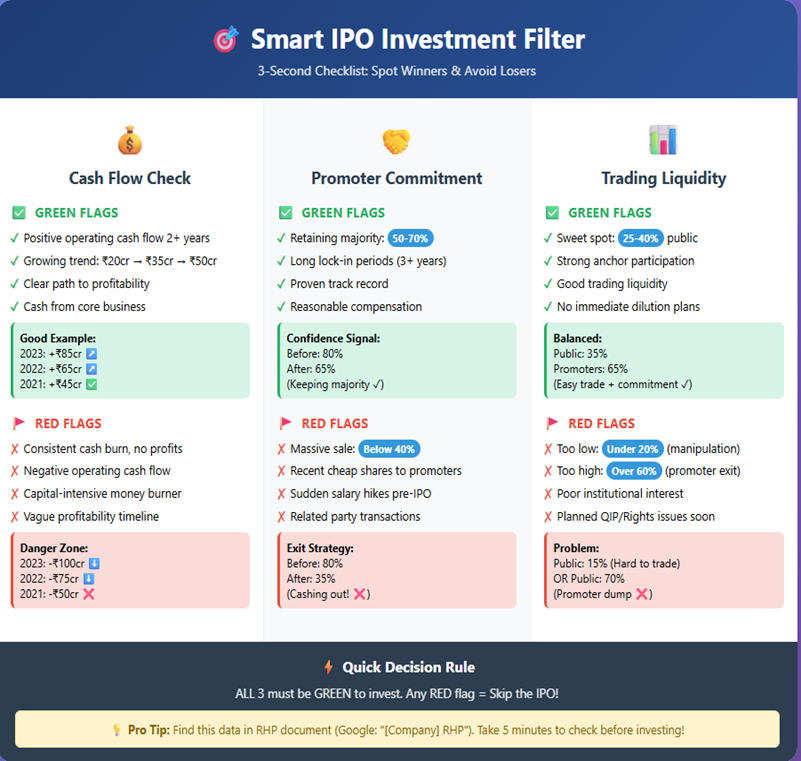
Look for companies with positive free cash flows or a clear path to profitability. For practical IPO evaluation, focus on actual operating cash flows from the company’s Red Herring Prospectus (RHP), which is available free on SEBI’s website or by Googling “[Company name] RHP.”
Examine “Operating Cash Flow” trends over the last 3 years. Consistent growth from ₹45 crores to ₹65 crores to ₹85 crores signals a healthy business. Red flags include consistently negative operating cash flows (-₹50cr, -₹75cr, -₹100cr) over multiple years with no clear profitability timeline.
Cash is king, especially in uncertain markets. A profitable restaurant chain generating ₹10 crore quarterly is far safer than a startup burning ₹5 crore per quarter with no visibility to profits.
2. Promoter Stake: Skin in the Game
While SEBI requires 20% minimum promoter contribution, smart investors look deeper. Do promoters truly believe in their business’s future? In the RHP document, find the “Shareholding Pattern” table showing ownership changes before and after the IPO.
Healthy patterns show promoters retaining 50-70% post-IPO (like 80% to 65%), indicating long-term commitment. Warning signs include stake reductions below 40%, recent cheap share allotments to promoters, or sudden salary hikes just before going public.
3. Post-Issue Float: Liquidity Matters
The floating stock determines how easily you can trade your shares later. From the shareholding pattern table, check the “Public” percentage after IPO, this is your trading float.
The sweet spot is 25-40% public float, providing good liquidity while ensuring promoters retain meaningful control. Avoid very low float (under 20%) which causes wild price swings, or very high float (over 60%), suggesting promoter exit strategies
Learning from the Disappointments: 5 IPO Failures That Tell a Story
1. M.V.K. Agro Food Product Ltd: The Commodity Trap
- The Hype: 8.46x oversubscribed, sugar production business looked attractive amid ethanol demand
- The Reality: Listed at ₹82.95 against issue price of ₹120, marking a 30.88% loss.
- What Went Wrong: High PE ratio of 30.84x compared to industry average of 18.81x revealed aggressive pricing. Revenue had actually declined from ₹130 crores to ₹93 crores in recent years, but investors got caught up in the ethanol story
- The Lesson: Commodity businesses are cyclical and capital-intensive. High oversubscription often reflects retail FOMO rather than institutional confidence in fundamentals.
2. JG Chemicals Limited: The Subscription Mirage
- The Hype: 28.52x oversubscribed, positioned as speciality chemicals play
- The Reality: Despite strong subscription, faced significant losses initially as input cost pressures materialized
- What Went Wrong: Investors overlooked the company’s exposure to volatile raw material prices and regulatory changes in the chemical sector. The subscription was driven by retail enthusiasm for “chemical story” rather than business economics
- The Lesson: High subscription numbers can be misleading. Chemical sector IPOs need deep analysis of input costs, regulatory compliance, and environmental clearances.
3. Hyundai Motor India: The Brand Premium Mistake
- The Story: India’s largest IPO at ₹27,870 crore debuted at a discount despite being an established global brand
- What Went Wrong: The IPO was essentially an offer-for-sale by the Korean parent, meaning no fresh capital for business expansion. Investors were paying premium valuations for a mature business in a competitive auto market with limited growth catalysts
- The Lesson: Brand recognition doesn’t justify any valuation. Even blue-chip companies can fail if priced beyond fundamentals, especially when it’s mainly a parent company’s exit strategy.
4. BikeWo GreenTech: The Green Bubble Burst
- The Damage: 23.79% listing day loss despite being positioned as an EV infrastructure play
- What Went Wrong: Company was pre-revenue with ambitious projections but no clear execution roadmap. The EV charging infrastructure space was overcrowded with similar promises but limited differentiation
- The Lesson: Theme-based investing (green/EV/AI) can create valuation bubbles. Always check if the company has actual revenue, competitive advantages, and realistic business plans beyond riding sector trends.
5. The SME Carnage: Quality Control Crisis
The SME sector experienced the most IPO failures in 2024, with companies from agriculture, steel, and green technology struggling to meet investor expectations.
Pattern Analysis: Most failed SME IPOs shared common traits – family-owned businesses with limited corporate governance, regional operations with poor scalability, and financials that couldn’t withstand scrutiny. Companies like Italian Edibles (51% loss) and Kalana Ispat (28% loss) showed weak fundamentals disguised by sector-specific stories.
Key Takeaway: SME IPOs need 3x the due diligence. The regulatory requirements are lighter, financial reporting standards are less stringent, and business quality can be wildly inconsistent. What looks like a “small Reliance” often turns out to be a local trader going public.
The Smart Way to Play IPOs: Your Strategic Framework
Strategy 1: The Dual-Timeline Approach
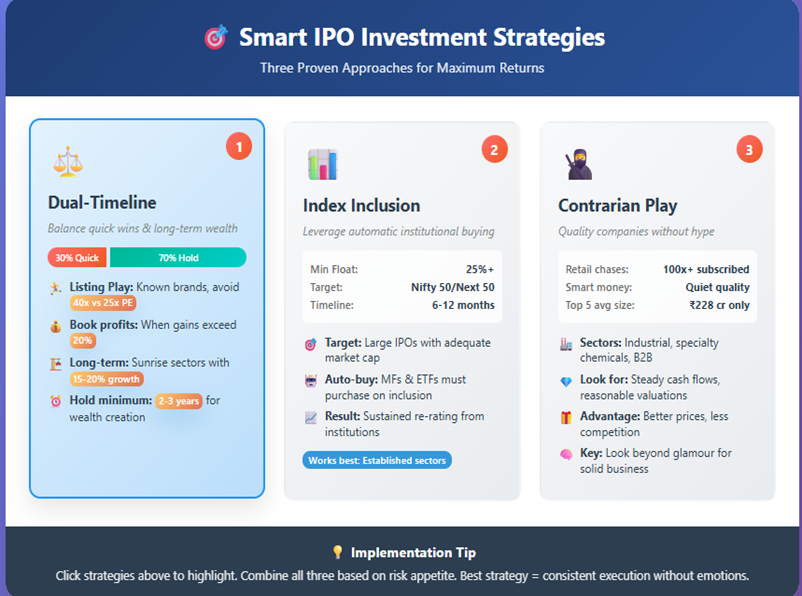
The Listing Play (30% Allocation): Focus on well-known brands with strong retail appeal that generate listing day excitement. Ensure reasonable valuations versus listed peers; if the IPO trades at 40x PE while similar companies trade at 25x, that’s a red flag. Book partial profits if gains exceed 20%.
The Long-term Hold (70% Allocation): Deep dive into business fundamentals—revenue consistency, competitive advantages, management track record. Evaluate whether this is a sunrise sector with 15-20% annual growth potential. Hold for 2-3 years minimum.
Strategy 2: The Index Inclusion Angle
Companies with 25%+ public float and sufficient market cap become eligible for Nifty indices. When inclusion happens, mutual funds and ETFs must buy the stock, creating automatic buying pressure. This works particularly well with large IPOs where index inclusion is probable within 6-12 months.
Strategy 3: The Contrarian Opportunity
While retail chases 100x+ oversubscribed IPOs, smart money targets quality companies that list quietly. Data shows the top 5 most subscribed issues average just ₹228 crore in size. Look for companies in unglamorous but profitable sectors like industrial components or specialty chemicals with steady cash flows and reasonable valuations.
Navigating the Road Ahead
India’s IPO market momentum in 2025 is unprecedented, with 100+ companies set to raise over ₹2 lakh crore. Technology & Fintech sectors benefit from government incentives and digital adoption. Manufacturing rides PLI schemes and China+1 strategies. Healthcare gains from post-pandemic awareness and aging demographics.
Watch for risks: Valuation froth as massive liquidity chases limited quality assets. Quality dilution in SME platforms with lighter regulatory requirements. Macro headwinds from interest rate cycles and global uncertainties.
In this IPO boom, real alpha comes not from riding every wave, but from carefully selecting which waves deserve your capital. Your bank account will thank you for the patience and discipline to wait for the right opportunities rather than chasing every hot issue that comes to market.
Remember: Past performance doesn’t guarantee future results. Always consult with a financial advisor and never invest more than you can afford to lose.